 Free Design Service
 RAPID Turnaround Times
 PRICE BEAT Guarantee

 0800 177 666











 Collections
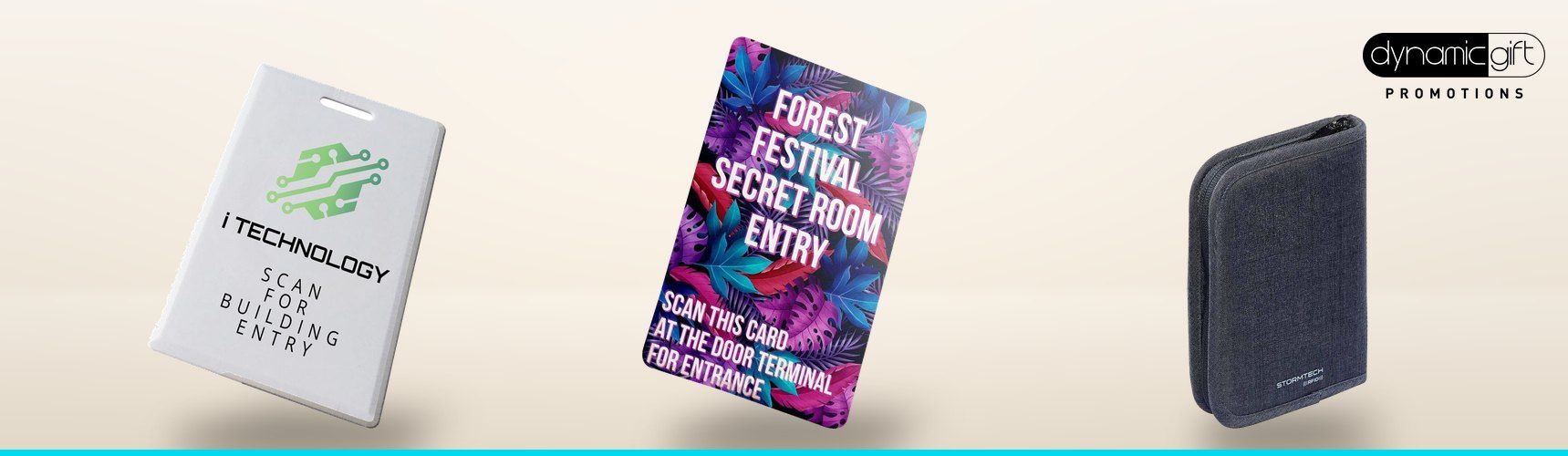
Someone in your building holds a card up to the reader by the door each morning and walks straight in. That tap is RFID, short for radio frequency identification. A reader sends out radio waves, a tiny chip in the card answers with its number, and the lock opens if that number is allowed.
In plain terms, the RFID meaning is identifying something by radio, with a tag that never has to touch the reader. Gyms, expos and warehouses put the same idea to work, and some client gifts are made to block it. We walk through five of those jobs as they look in a New Zealand business, with what we would make for each.
Where Do Businesses Use RFID Technology?
Four of the five uses below put RFID technology to work in one of two ways. It proves who someone is, like a staff pass or a gym key tag, or it tells you what something is, like a carton of stock. The fifth turns that around, making a card harder to read.
1. Access Control: Offices and Work Sites
Access control is that morning tap at the office door. A staff pass held near the reader is checked against a list of allowed passes before the lock releases. RFID badges are widely used for this, replacing the magnetic stripe cards that came before them.
Readers differ from site to site, so each pass must carry the chip your reader expects. We make RFID and NFC access control cards to order around the make and model of the scanner you already have.
2. Member Sign-In: Gyms and Clubs
Gyms and sports clubs use the same tap at the front desk. A member holds a card or key tag to the reader, and the visit is logged against their membership with no paper sign-in sheet. It does the same job as a barcode, without lining anything up under a scanner.
Our printed flat RFID card suits this well, with full colour branding on both sides. It comes in CR80 and CR79 card sizes, a 54 x 29mm key tag or a custom size. A key tag lives on a keyring, which suits members who arrive with only their car keys.
3. Event Passes: Conferences and Expos
At a conference or expo, the pass around each neck can do more than show a name. A chip in the pass lets registered guests through the door, just like a staff pass at the office. With an NFC chip inside, a guest can also tap the pass with their phone to open your web page.
Our printed event passes come in plastic, laminated or variable data options for events, workplaces, schools and venues. Variable data printing changes the text from one pass to the next, so every guest gets their own name. Chip cards sit in the same range, so you can order printed and scannable passes together.
4. Inventory Tracking: Stock and Equipment
Warehouses and shops use RFID tags to count stock without scanning items one at a time. A barcode has to face the scanner, but a tag can be read inside a carton, and a reader can pick up hundreds at once. Businesses use the same tags for asset tracking, so tools and equipment are identified without anyone typing in a code.
Our RFID stickers attach to any product and print in CMYK full colour, so a tag can carry your logo as well as its chip. They come in 20mm and 25mm sizes as standard, 1mm thick, with custom shapes on request. Give us your scanner's make and model, and we supply the chip it reads.
5. RFID Blocking: Client Gifts and Welcome Packs
RFID blocking does the opposite job, shielding a card from readers instead of helping one find it. Smart cards and access badges are hard to read when they sit within a few centimetres of a metal surface. So a metal-lined holder makes the card inside much harder to read.
Our RFID card protector is a plastic holder with an internal metallic foil lining, sized W 88mm x L 58mm x 5mm. It takes your logo on the front and back and comes in a range of colours. As a gift it gives clients peace of mind, and it arrives loose packed, ready to drop into a welcome pack.
How Does RFID Work?
Each of these RFID use cases depends on the same set-up, even the one that blocks it. Each part has one job:
- Tag: an RFID chip joined to a small antenna on a thin base, set inside a card, sticker or pass.
- Reader: a device with one or more antennas that sends out radio waves and listens for the reply. An RFID reader can be handheld, mounted on a post or built into a room.
- Records: the database the reader checks a tag's number against, such as the list of people allowed through a door.
A passive tag has no battery, because it runs on energy from the reader's radio waves. An active tag carries its own battery, so it can be read from further away. Either kind can hold anything from a single serial number to several pages of data, according to the US Food and Drug Administration.
Frequency is the detail to get right when you order. Some readers run at 13.56MHz and others at 125kHz. We make the printed, plain and sticker cards in our RFID and NFC range to suit the one you have.
What Would We Make for Each Job?
For each of the five uses, the table names the product we would start from and its format.
| Use | What we make | Size or format | Good to know |
|---|---|---|---|
| Access control | RFID and NFC access cards | Printed, plain, flat and clamshell styles | Chip matched to your reader's make and model |
| Member sign-in | Printed Flat RFID Card | CR80, CR79, 54 x 29mm key tag or custom | Full colour branding on both sides |
| Event passes | Printed Cards & Passes | Plastic, laminated or variable data | Chip cards in the same range |
| Inventory tracking | RFID Stickers | 20mm or 25mm, 1mm thick | Custom shapes and sizes |
| RFID blocking | RFID Card Protector | W 88mm x L 58mm x 5mm | Internal metallic foil lining |
Every row with a chip starts from your reader's make and model, so have it ready.
Five Details That Shape an RFID Quote
Have these ready before you ask, because each one changes the quote we write. Quotes are free and come back in New Zealand dollars.
- Your reader: the make and model, or the frequency if you know it.
- The job: door access, sign-in, event entry, stock or blocking.
- The format: card, key tag, sticker, pass or holder.
- Your artwork: a logo for one side or both, which our design service sets up for free.
- Quantity and date: how many you need and when they must be in hand.
Rush service is listed on the cards, stickers and protector for dates that will not move. Before anything prints, you approve a free artwork proof, so a misplaced logo is fixed on screen rather than on the finished cards.
Before Your First RFID Run
At Dynamic Gift, we are a New Zealand owned and operated business working from 22 McColl Street in Newmarket, Auckland. Cards printed in our factory ship NZ wide, and our lanyards and ID accessories range adds the straps, holders and reels needed to finish each pass. Ask about a free sample when you request your quote, since most of our products offer one.
We can price your RFID order with a free artwork proof as soon as you send your reader's make and model, your logo and the quantity you need.
Frequently Asked Questions
What is RFID in simple terms?
RFID is a way for a computer to identify something by radio. A small electronic device called a tag is fixed to an object or carried by a person. When it comes near a reader, it sends back its identity, with no contact or line of sight needed.
What does RFID stand for, and is it new?
RFID stands for radio frequency identification. The technology has been available commercially in one form or another since the 1970s, so it is far from new. It is now part of daily life, inside car keys, employee ID passes, highway toll tags and security access cards.
What does RFID mean on a wallet?
It means the wallet is sold as RFID blocking, made so the contactless cards inside are harder to scan without you knowing. Shielding works because smart cards are hard to read within a few centimetres of metal. Our card protector does the same for a single card, with an internal metallic foil lining.
Do RFID tags need a battery?
Passive tags do not, because they run on power from the reader's radio waves. Active tags carry a battery, which lets them be read from further away. Door badges only need to be held near the reader, and a passive tag is cheaper and smaller because it has no battery.
Does a New Zealand passport have an RFID chip?
Yes, every New Zealand passport applicant since 4 November 2005 has received an e-passport with a microchip holding their photo and passport details. It is a contactless RFID chip built to the international e-passport standard, with anti-skimming and encryption technology added by the Department of Internal Affairs. At the border, NZ Customs eGates match your face to the photo in your ePassport.


 22 McColl Street, Newmarket, Auckland 1023
